taijimasters

taijimasters
Fu Zhong Wen, Yang Chen Fu, Yang Shao Hao, Sun Lu Tang, Wu Chien Quan, Ma Yueh Liang, Tung Ji Yieh, Chen Wei Ming (below Sun Lu Tang)

Monday, August 12, 2013

"Grasp the Bird Tail", "4 Square" and other training comparisons in the Yang Family, Zheng Man Qing, and other Yang Taijiquan variations


Last update to this page 8/31/2013

While this post seems to 'bash' Zheng Man Qing/Cheng Man Ching...it really concludes that there are some excellent qualities he did actually have. It is really an analysis of the "Yang style" curriculum and what some are doing and what others are not. I never met the man, so I can not make a judgement, however I show positive and negative aspects. His legacy continues with great teachers as William CC Chen, Ben Lo, Huang Sheng Shyuan, Liu Xiheng, Robert W. Smith, and others. With teachers of that level, I conclude he had a level of gong fu that is worthy of talking about.

Zheng Man Qing (ZMQ) is a well known disciple of Yang Chen Fu (YCF), yet his system of Taijiquan is missing an extraordinary amount of drills and trainings that are common in its mother system of Yang Taijiquan. While he popularized Taijiquan in Taiwan and USA, his system is more well known in the free world and often considered by most the standard complete form of Taijiquan. I am not sure why I often get so much backlash from ZMQ players when I try to present training techniques and drills that are used by the Yang Family system. As someone who started ZMQ Taijiquan in late 80's and continue to practice, I am starting to get annoyed with the level of close-mindedness the ZMQ community has toward their root system. I suppose, since if it did not come from ZMQ then it isn't in Taijiquan right? No. ZMQ's Taijiquan is a simplified version of Yang Taijiquan's Long form. The ZMQ short form has 37 postures and is missing a great deal of many Long form postures. For example: Part horse Mane, Needle at Sea bottom, Turn and strike series/White snake spits tongue, Strike Tiger left and right, high pat horse, open Fan, and a few others were excluded in ZMQ's short form.

Fan through Back:
Part Wild horse Mane
High pat Horse
Needle at bottom of Sea
Turn and strike

Zheng Man Qing's short form and push hands-


Yang Long Form


Masters and Teachers on why ZMQ students to should learn from the source:

1. Da Liu, a student of ZMQ says in his book, at page 2 of 'T'ai Chi Ch'uan and I Ching', Da Liu says: "The long form of the Yang school has 108 different postures. It is like the Yangtze River, long but gently flowing. It lasts fifteen to twenty minutes when fully comprehended. The professional T'ai Chi student should learn this form. The short form, which is recommended for the average student, is much easier to learn, comprising about fifty forms and taking from seven to ten minutes to perform. It is good for the office worker and for people who wish to improve their health and can be practiced two or three times a day." (from Yang Family forum)

2. Regarding Yang family comments on Cheng Man-ch'ing, Fu Zhongwen stated in an interview published in Inside Kung-fu, April 1993: "Cheng Man-ch'ing is probably the most famous taijiquan teacher in America. I knew him when he came to Shanghai to study with my uncle Yang Cheng-fu. He was a very great artist. He was very interested in learning and practicing taiji tui shou (push hands), which he did quite heavily with Yang Cheng-fu and all those around him who were the most skilled...Cheng Man- ch'ing was legitimate, and now it is important for his students and other North American practitioners to research where 'they first drank the water.' The traditional methods of the Yang family style must be preserved..." The preceding excerpt from Fu Zhongwen's comments is most pertinent to the current discussion, but he went on to say that he felt that he saw differences in the way the short form and long forms were done.(from Yang Family forum)

Fu Zhong Wen and son Fu Sheng Yuan

3. Lastly, my first taste of Taijiquan came from a local teacher in Virginia Beach named Larry Mann, who taught the ZMQ's Short form and hosted Ben Lo seminars. He was the first to tell me, "The short form comes from the Long Form. Yang Zhen Dou is teaching a seminar up in Washington D.C., I suggest all my students go and learn this form from Yang Family inheritor Yang Zhen Dou" He then proceeded to hand out a flyer for the event.

I think a big major problem of this is due to ZMQ being a much later disciple of Yang Chen Fu in the early 1930's before YCF's untimely death, and not getting all the training and lessons as YCF's sons and relatives had received. The following drills I demonstrate come from the lines of Yang Zhen Jie (oldest surviving Yang family member) and Fu Zhong Wen (nephew of Yang Chen Fu).


Tui Shou and other differences:

1. 'Grasp the Birds Tail', various single hand, double hand, and moving step partner drills (first 5 minutes of this video)is one of the first partner trainings a novice person who learns the Yang long form will learn. It contains the essence of the applications so that when the person trains in the solo form and does the "Grasp Bird Tail" series of movements, they are aware of how to use and visualize the intention on the core movements of Pung (Ward off), Lu (Rollback), Ji (Press), and An (Push).

2. Four Square Tui Shou in the Yang System (starting at beginning of video)- Four square is another understanding of the energies of Pung, Lu, Jie, and An in a fixed pattern for Tui Shou. The fixed pattern contains the essence of the 4 core/square movements and trains the practitioner to understand the energies of:

Teng Jing (listening energy): the ability to feel precisely the direction of the push on contact.

Nian Jing (adhering energy): the ability to stick and keep in contact with your partner.

Hua Jing (neutralizing energy): the ability to neutralize the force directed towards you.

Lian Jing: (Continuous, connected energy). the ability to be connected in order for your reactions, to any attack, to follow the principle that as soon as your opponent moves.

Mian Jing: (Cotton, soft energy). the ability to use sensitivity that you achieve enables you to detect even the slightest changes in the movements of your opponent.

Sui Jing: (following energy). the ability to follow if the opponent steps either back or forwards.

Bu Dio Ding: Never loose contact and avoid using force against force.

Fa Jing (explosive energy): the ability to project your own chi and throw your partner away.

Yang Zhen Dou and Yang Jun of Yang Family
Yang Jun video on Push hands

3. Four square in the ZMQ system is called "Sui Zheng Tui" video (Starting at :29 sec) : this is totally different and modified from the previous version and not seen or found in other Yang Family style. Tung family,Fu family, Yang family, none of these families who studied with Yang Chen Fu practice this variation:


4. Da shou or striking hands video before Tui shou there was "striking hands" partner drills that used striking and parrying similar to "step-parry-punch" and other sections of the Long Form. These are flow drills that are not seen in many styles of Taijiquan. A private video is available upon request on my Youtube if you have a Youtube account.Find me there and send a request.

5. 88 two man fight set (Partner san shou) and Fast frame forms- these are controversial forms even for the Yang family today. It is widely practiced by people who studied with the Yang family. Yang Chen Fu was said to have teaches a Long form and Long fist fast form. Chen Wei Ming's book on Yang Long boxing fast form. Tung family teaches this, Chen Wei Ming, fast forms are in the Imperial Yang Taijiquan system and Wu Jian Quan's Taijiquan system. My ideology on the 88 two man set and fast frames is based on the Tibetan mandala, "Pacify, Enrich, Magnetize, Destroy." My interpretation is this: Pacify: be a skeptic and question it. Enrich- learn it and make distinction, find usefulness. Magnetize- learn all you can from it, digest the knowledge, go deep and make it a part of your gong fu. Destroy- let go of it, you have gotten as much as you can from it, it is contrived and not true free fighting, it is a tool and the tool has done its job, move on. Book containing the 88 two person set translation: Chen YanLin student of Tian Zaolin (disciple of Yang Jianhao and Yang Chen Fu)

Some benefits from Fast forms and the 88 two man set:

1. They teach varying speeds, stepping patterns, various Jings such as listening, adhering, following, etc.

2. Many traditional kung fu system have two man fight sets to train qualities and attributes of the system. The 88 two person set is no different containing attack and defense, counter, qin-na, anti qin-na, timing, distance, bridging, and other fighting attributes.

3. It makes for a beginner a great start before going into real sparring, it trains lines of attack that you can not get from push hands and moving step push hands. see previous blog post: 25 lines of attack.

4. Yang Tai Chi was originally taught using various speeds. A real fight is fast, you have to train to move fast. The Taiji classics say, "If my opponent moves fast, be fast, if opponent moves slow, follow slowly."


Tung family Fast Set video


Wu Jian Quan's Fast set video


6. Solo fajin, and linear step work: this was taught in our school when I was with Weiqi a disciple of Fu Zhong Wen founder of Yongnian Taiji Association, I have also seen this practiced in Yongnian group in Thailand and in China. Basically it is taking a single movement and repeating it with linear and angle stepping.

Fu zhong Wen fajin video


Fu Sheng Yuan fajin video


7. Da Lu- 4 corners is the only similar training set that is similar in the ZMQ and Yang system, there is not much difference in the training between these two drill. Some slight variance, but in essence the same.

Da Lu video sample video:


8. Warm-ups and stretching sets- there have not been many ZMQ schools that do warm ups, stretching, and other basic gong training. The ZMQ school does however have a strong standing training using the form for holding and molding postures, but standing training is common in about all Taijiquan schools. ZMQ's student Huang Shen Shyang of Malaysia who was a well know white Crane boxer also had a 5 loosening exercises. I also blogged on ZMG teaching some basic drills 5 Commitments and 8 ways to assist in Taiji short form but they are not considered warm-ups or stretching.see video

Yang Family warm-up sample video:


Huang's 5 loosening exercises video


James Fu Tai chi warm-ups video

9. Moving step push hands, Yin/Yang push hands and circular stepping push hands: this is practiced in many places but I have not trained this at ZMQ schools. They train a whole lot of fixed step push hands but not moving step. The first video shows some more of the patterns and moving step. However this video should be much clearer. (see around 6:00 for moving step and 6:50 mark for yin/yang and circular yin/yang).


The solo Broadsword and Spear set along with the two person Spear set is also excluded from ZMQ's Taijiquan.


Taiji Saber/Broadsword video


Taiji spear/pole basics video


10. Yang Taiji Straight sword- The Yang family, Fu family, Tung family, and others all pretty much have the same Straight sword (Jian) form. This is good. Each might have very slight differences or variations, but the names and choreography is nearly the same.

Zheng Man Qing's straight sword form video-


Yang's Taiji Straight sword video


11. Sword play- fixed set and freeplay: some schools of Taijiquan have a paired set that teaches sword play techniques similar to the 88 two man set. ZMQ had freestyle sword play with wooden swords at his school These are both very good in training some of the usefulness and techniques of the sword.


Taiji sword paired set (sometimes called Wudang swordplay) video-


ZMQ and student with sword freeplay video


12. Tui Shou competitions and San shou fighting competitions: Here is a major difference in the ZMQ and other Yang groups have. There are more Tui shou and San shou top athletes of the ZMQ school (in particular William CC Chen's and NYC schools) willing to compete and fight in National and International Tui Shou and Lei Tai/San Shou fight events that out shine anything Yang, Fu, Tung and other Tai Chi groups have done.Some of the top players have been william CC Chen's students and kids: Peter Ralston, Tiffany Chen, Max Chen have been on USA San Shou team and Lei Tai teams. Others Tui Shou competitors include: Mario Napoli (who won in Chen village), Avi Schneier, Mike Pekor, Lenzie Williams, David Walls-Kaufmann,Josh Waitzkin, to name a few (many others). I have not seen many other Yang family or other groups really show much of a showing at major competition events.Other notables: John Signarello of CK Chu's in NY and Patrick Brady of Little River Tai Chi center have both won Lei Tai championships on numerous occasions.


Mario Napoli winning in Chen village: video


Max Chen (William CC Chen son)highlight video


John Sigarello of C.K. Chu's Tai Chi (.45 sec, 1:45, 2:00, 3:09, 5:41 of video)


Patrick Brady of Little River Tai Chi video


Author of this article, Matt Stampe Lei Tai, San shou, and Push hand clips (ZMQ, Fu family (Yongnian Taiji), Yang family association member):


13. Pai da gong: Limb and Body conditioning/warm down solo and partner drills- I have only seen this done in our class that was handed down from Fu Zhong Wen. I have not seen this anywhere except in a Shaolin class (that was done much harder) and in a Pakua chang class which was done entirely differently. In the solo set one lightly to heavy palm hitting the limbs. There is a partner set of hitting the arms, shoulders, thighs, hips, and more. I had a video somewhere of me performing some of these solo and with a partner.

14. Taiji Qigong, Massage,and meditation exercises- Back when I studied with Xianhao Cheng we had some Qigong sets that were done using "Golden Bell" breathing. we were told to abstain from sex as much as possible (was told this when I was 18 when training in Taiji and Qigong) and we did a particular qigong set that was supposedly done in the Yang family tradition as taught in Hangzhou China.

When I studied the two man 88 partner "San shou" exercise at Qi Elements school of Taijiquan and Massage, I took up learning massage. I had already done Chinese acupressure massage with my first teacher Wilson Pitts, a student of Amy Tseng. Back then, I was told that many of the younger students of Taijiquan, had to use Tui Na massage on many of the Instructors and Senior students to learn the meridians used in Traditional chinese medicine (TCM). The student had to learn the pathways that qi travels, and understand the cavities, joints, bones, sinew, and muscle attachments sites. At Qi Elements, my teacher Sifu nancy Bloomfield, a student of C.C. Liu of D.C.'s Chinatown, taught a massage style called "Taiji massage" in where you use Taiji when you massage someone on a table. That is, using push on the limbs and back of a patient.

The only meditation I have learned is a visualization using standing meditation that was taught by Fu Qing Quan, Fu Zhong Wen's grandson. This is very similar to some of the standing meditations used in the art of Yiquan. I have learned some sitting meditations in Pakua chang. There was also some standing meditation in the ZMQ's style with concentration of 20 cycle breathing at the tan tien while holding wu ji, embrace tree, and other postures.

Old pictures of Tui Shou and Da Lu.

Thursday, June 20, 2013

Spotlight: Tai Chi fighter Nick Osipczak UFC veteran

found this on Rumsoakedfist.org forum he is def a new member of our IMA hall of fame at IMA "hall of fame" unofficial website
Nick trains in England and is a veteran UFC fighter. He teaches 24 form Taijiquan and feels that Tui Shou or "push hands" is a benefit to his stand up grappling game.

teaching Taijiquan:

see more at:Raised Spirit website

Thursday, March 28, 2013

Cheng man Ching's: 5 commitments and 8 ways


My friend has been corresponding with a gentleman who studied with Cheng Man Ching and had trained in Taiwan and NYC.

5 commitments:
1. stand in root, bone line balance.
2. Stand at edge of a precipice.
3. Be reluctant to act, learn from losing.
4. Continuously soften your touch.
5. Do Not reposition the hands.

Professor CMC’s 8 ways: solo exercises for push hands.
1.      Plying the Oar- loose orbital movement relating to the posture, push, while transferring weight from front to back.
2.      Chasing the clouds- (only have commentary) wave hands clouds. when you turn your hips there is a tendency to pull the rooted foot off the bubbling well and towards the edge of your foot or heel. Chasing the cloud practice is important because the root is strengthened by coupling moderate turning with careful positioning of the central channel through the bubbling well.)
3.      Walking in the stream current: walking with or against an imaginary current develops continuity in movement and pliability in stepping. This practice is excellent for recovering from ankle injuries where the supporting the body where weight on one foot has become troublesome.
4.      Walking on thin ice- Walking with the feet parallel relates to the posture “repulse monkey” but advances forward while using an empty step. This helps develop sure footedness and opens the lumbar area.
5.      Standing at edge of a precipice: borrowed from the posture White crane, this motionless exercise presents an opportunity to deepen the root and build reliable 100% balance on one foot at a time. Lift hands and play guitar can be used as well.
6.      Riding the wind- similar to diagonal flying, this exercise introduces a movement that prepares you to contact opponent under his armpit or at the side of his ribcage.
7.      Setting the sail: this exercise is borrowed from Fair lady weaves shuttle. It is intended help loosen the waist and integrate the whole body movement from a carefully focused diagonal attacks. Be careful to keep the leading arm, which guards the temple, soft and relaxed at the shoulder.
8.      Wearing the moon on your head- keeping the head softly balanced above the root helps lighten movement and improves the ability to make use of relaxed dispassionate observation. (all previous postures 1-7) integrate top of head with bubbling well.

Monday, August 6, 2012

Shuai Chiao Stances with John Wang

A Valuable John Wang Post @RSF:

The funny thing was GM had never used the term 十三太保. He only taught 12 ZZ instead of 13. I had to fly to China to meet his brother to find out the missing one. When I asked his brother in hotel in Beijing, his brother asked me to hold on his waist, he then did the missing one, 旱地拔葱(Han Di Ba Cong) Pull onion off a dry ground. I then understood why GM Chang didn't use the term 13 Tai Bao. How can you call your ZZ training 13 Tai Bao if you only taught 12 ZZ moves? I assume toward his old age, he couldn't do 旱地拔葱 (Han Di Ba Cong) Pull onion off a dry ground without someone held on his waist. He had too much pride and would never allow anybody to help him on that.

I had made it into a short form so people can easily remember. Of course the order is not important. Even my young student still could not do the 1st 旱地拔葱 by moving her body up and down with single leg standing.

1. 旱地拔葱 (Han Di Ba Cong) Pull onion off a dry ground
2. 李奎磨斧 (Li Kui Mo Fu) Li Kui sharps the axe
3. 仙人照鏡 (Xian Ren Zhao Jing) Angle look at mirror
4. 钝链割谷 (Dun Lian Ge Gu) Dull sickle cut rice
5. 舍身探海 (She Shen Tan Hai) Sacristy body and dive into ocean
6. 魁 星点斗 (Kui Xing Dian Dou) Kui Xing points at star
7. 烏龍戏水 (Wu Long Xi Shui) Black dragon plays with water
8. 羅漢观天 (Luo Han Guan Tian) Lou Han looks at sky
9. 燕子超水 (Yan Zi Chao Shui) Swallow skips water
10. 合卧 (He Wo) Combine stance
11. 古樹盤根 (Gu Shu Pan Gen) Old tree twist the root
12. 托天式 (Tuo Tian Shi) Lift the sky
13. 三平 (San Ping) Three plains.

Wednesday, May 23, 2012

Inner Muscle Training of Boxers with David Bolton

*To get a copy of the book, it is now available at Amazon.com* Lost Secrets to a Great Body by Dave Bolton here on Amazon.com

Recently at rumsoakedfist.org I started a thread on musculature of some of the old school boxing training based on an article by Wilson Pitts. The article by Wilson is here. Charley Goldman Boxing. This article prompted the question of what may have been the training to reach some of the inner muscles of the body. I got response from David Bolton in the U.K. and he shared his insights in the thread. David also sent me a series of files from his book to share here on the blog to add to the thread.

Here is the file:  


     Although many boxers today train with weights, from the 1800s up until as late as the 1980’s it was considered an absolute no-no in boxing. Boxers and boxing trainers believed that weight lifting (with heavy weights) would be detrimental to their fighters, slowing them down and making them less powerful and less agile. Traditional Chinese martial arts teachers had (and still have) the same ideas.
These ideas are laughed at by sports scientists in boxing today who point out that this assumption is ridiculous – an overall increase in strength can only make you faster and more powerful they point out – and so they look upon the old trainers as merely ignorant and ill informed.
The thing is they weren’t ill informed and they weren’t stupid – they knew exactly what they were talking about. It’s just that modern readers have misunderstood them. They weren’t saying that extra muscle gained through lifting heavy weights would be bulky and slow down their fighters that way – they were saying that the kind of neurological adaptations one’s body makes when training to lift heavy weights tends to be incompatible with boxing.
They felt a boxer needed a strong but finely controlled musculature – perfect neurological communication between mind and muscle – so that he could whip out a punch into a fleeting gap in a defence or move his body in any direction in an instant. They felt that heavy weight lifting developed a different kind of neurological adaptation and that it was best left alone. Strength on the other hand they KNEW was vital.
Modern Chinese internal martial arts have kept this bias against weight training so for my supplemental fitness training I religiously avoided heavy weights and a body building type approach. I mainly worked out for fitness with bodyweight movements, rope climbs and suchlike. A few years ago I injured my right elbow badly enough to mean I couldn’t train properly for about six or eight months and while I could still do lots of elements of my internal martial arts training I had to stop completely any supplemental fitness stuff.
When the elbow had healed I’d got used to spending all the free time I had practicing and didn’t want to give up a significant chunk of that to supplemental fitness exercises but neither did I want to just make do with how I looked as a result of my practice (I may have been functionally and aerobically “fit” but I felt I “looked” out of shape and I didn’t like it).
Around this time I read all the books on the old-time strongmen and started to suspect that the light dumbbell protocol that kept cropping up in these books was more than it seemed – and might offer me a solution. Because it would be a way to ease my elbow back into exercise and it would only take me fifteen or twenty minutes in the evening I thought I would try it out just to see what would happen. The results I got were way better than I had hoped and so I’m still doing it and this is the ONLY extra conditioning I do outside of regular internal martial arts practice.
Quite quickly though, people within the arts I practice started mentioning my increasingly visible results, assuming that I was training in a bodybuilding fashion with heavy weights. They warned me that this extra bulk and the “wrong way” in which I would inevitably be learning to use my body would wreck my performance and preclude me from developing real skill. They thought I would be “muscling” all the applications instead of using relatively relaxed and unified, intelligent, whole body force.
No matter how much I told these people that I was most definitely NOT training with heavy weights and that in fact I felt the exercises were facilitating a GREATER ability to control (and therefore appropriately relax) and use my muscles, they wouldn’t believe me.
Then I discovered that this debate had happened before and that these very exercises had been used in the past by famous boxers – those exact ones that warned against heavy weight training. Like Sandow before them they had known the value of the light dumbbell protocol, had known it was NOT weight training as such, and known it provided a kind of strength and neurological adaptation that was extremely useful to them.
When Sandow was extensively measured and tested in America by Dr Sargent, one of the men present was the famous middleweight champion boxer Mike Donovan. Donovan competed with Sandow on several tests with equipment that measured the speed of the arm movement when delivering a blow. The reason for this test is very clear – Donovan was particularly famed for his speed and the tests were to see not “if” but just how much Sandow’s comparatively huge muscles slowed him down.
Everyone present was astonished to note that Sandow’s punch was more or less equal to Donovan’s – the boxer only beating him by the narrowest of margins. Much was made of the fact that Sandow had “a tremendous supply of nervous energy which he was able to use only when necessary” – he was “able to use only those muscles necessary for performing any action, those not in use were in a state of complete relaxation.”
It is precisely this type of neurological adaptation that is necessary in boxing and that boxers (and some traditional martial artists) felt heavy weight training would ruin. Basically, pushing the kind of weight that makes you unthinkingly tense ALL the muscles in the arms, back and chest at once in order to wrestle the weight up or outwards builds a neurological pattern where all the muscles learn to “fire” at the same time. This would effectively be like trying to drive a car forward with the handbrake on and would slow you down and cause you to use more energy than necessary with every punch.
Clearly the type of development Sandow had built did not have this effect on his movement. This supposed side effect of weight lifting was to do with the concept of someone being “muscle-bound”. Today we think of this phrase to mean just somebody with lots of muscular development whose size somehow gets in his way when he moves about but that is not how the term was used at this time.
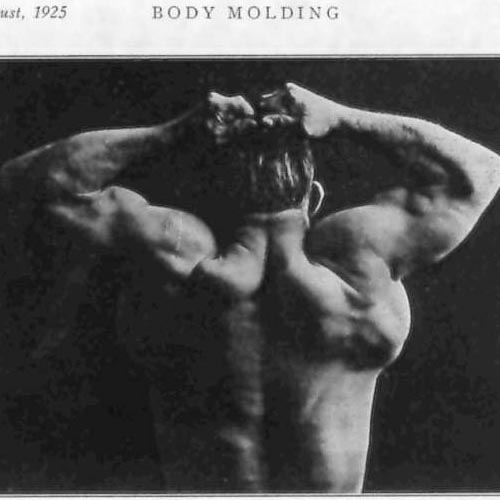
The term very specifically referred to a state of affairs where the action of one muscle was unconsciously “bound up” with the action of another muscle – someone who cannot contract the bicep and at the same time completely relax the triceps is by this definition “muscle bound”. Maybe you’ve seen those odd old- time physique poses where the muscle man stands with his back to the camera with both hands stretched above his head and the fingers interlaced and pulls apart so that his shoulder blades wing right out to the sides and almost dislocate? There’s some youtube footage shot by Thomas Edison of Sandow performing this exact feat.


Famous muscle control expert Otto Arco performing the back display 


This was done to demonstrate something very specific – when the demonstrator pulls on this fingers strongly he contracts the muscles that pull the scapulae together at the top and at the same time purposely turns off the muscles in the mid back that pull them together there – allowing the full opening of the scapulae out to the sides.
If you adopt this pose and pull the hands apart strongly and ALL THE MUSCLES OF YOUR BACK FIRE SIMULTANEOUSLY - so that the scapulae stay where they are - then you are muscle bound by the original definition. This pose was to demonstrate that the person doing it most definitely wasn’t. Ironically many people who have never touched a weight in their lives are muscle bound by this original definition.
If you habitually contract all your muscles at once in a strength feat – say the bench press – because it takes everything you have to get the weight up there, then unconsciously you are training your muscles to all go on at once and it is this neurological factor that the old boxers were referring to when they said weight training would make their fighters “muscle bound”.
The light dumbbell protocol as taught to Sandow by Attila, however, specifically avoids this – it starts by teaching separate and maximal control of all the muscles with weights light enough to allow one to choose which ones are involved and to exactly what degree. It makes one “strong” in a very particular way – it gives precise control over each muscle and teaches you to consciously contract it very hard or turn it off altogether, thus fine tuning the very important neurological component of strength.
You might remember earlier in the chapter on Professor Attila that it was mentioned that several very famous sportsmen and athletes of the day were pupils at his famous studio. One of these men was the Heavyweight Champion of the World at the time - the famous “Gentleman” Jim Corbett.
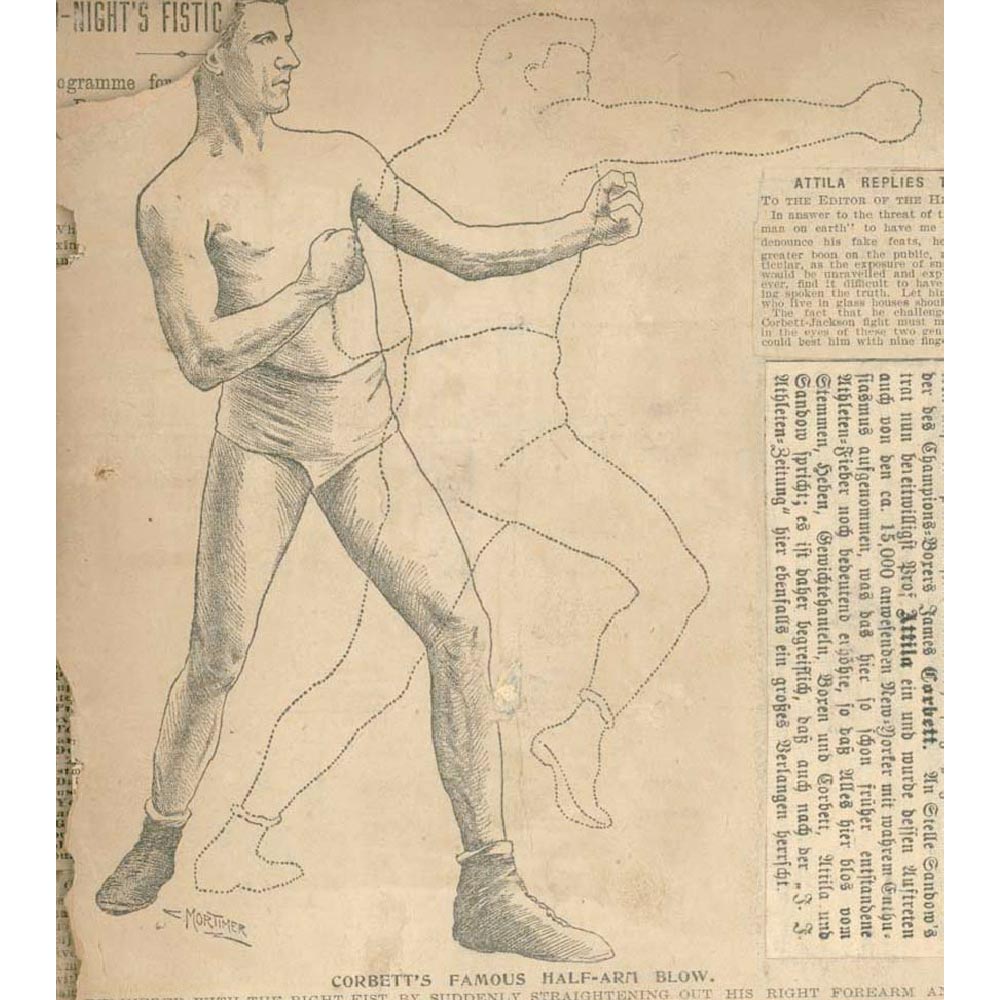
Before Corbett’s fight with the Englishman Charlie Mitchell in Florida in 1894, Attila famously trained the Heavyweight Champion in his five pound dumbbell exercises – tailoring the particular moves to concentrate on improving his muscle mass and working on the muscles involved in throwing his famed left hook (which he is credited with inventing incidentally) and his “right hand half hit”.


 Corbett’s right half hit
(Picture courtesy of Jan and Terry Todd, H.J. Lutcher Stark Center for Physical Culture and Sports)

This last blow, as we can see from an illustration included in an article in the scrapbook, is identical to the traditional martial arts “lunge punch” and also is essentially the same as exercise 11 but with a full step through. Mitchell was smaller and lighter than Corbett but had given the much Larger John L Sullivan a difficult fight and was noted for his speed so it was essential that any training Corbett undertook did not affect his speed and dexterity.
Corbett had the worst of the first round then dropped Mitchell in the second and then again three times in the third to win by a fairly fast KO. Until this point Corbett was not a noted puncher.
In the Attila scrapbook there is a clipping that records the fact that at the bijou theatre in Brooklyn Corbett presented Professor Attila with a gold locket to officially and publicly thank him for the training he had received before the fight in Florida.


The new champion Corbett meets veteran Jem Mace


A noticeably more muscular James J. Corbett in 1894 after the dumbbell training


The face of the pendant is graced with a picture of Corbett in fighting costume while the reverse bears the forearm and paraphernalia of Attila’s five pound system

Elsewhere in the scrapbook Attila also includes an actual letter of thanks from Corbett:

This is the first opportunity since the fight to drop you a line – although we saw each other for a moment at Madison Square Garden – I wish to express to you my great satisfaction with your five pound dumbbell system which you were kind enough to teach me at Asbury Park last fall and which I have practised ever since – carrying also in my daily excursions one of your 8 pound walking canes which you presented to me on the day I left New York.
Well, old boy, it did me a great deal of good. I must say it is a wonderful method and might have had not a little to do with my recent success.
I should like to present you on a benefit occasion on my return to town with a public testimonial. Accept for the present my most sincere thanks – good luck in America, I remain your friend. Signed JAS J Corbett”.

(All references and quotes from Attila’s scrapbook are included Courtesy of Jan and Terry Todd, H.J. Lutcher Stark Center for Physical Culture and Sports)

In Patrick Myler’s biography “Gentleman Jim Corbett” whenever the Champion’s fight preparation and conditioning is mentioned after the Mitchell fight it always includes work with light dumbbells. Although this is the only official mention of the light dumbbell work ever being linked to boxing, Corbett certainly wasn’t the only boxer to recognise its value.
On July 4th in 1910 one of the most celebrated and contentious fights in the entire history of boxing took place in Reno Nevada. The first black heavyweight champion – the prodigiously talented Jack Johnson - was challenged by former champion Jim Jeffries the original “Great white hope”. Such was the interest in this colossal match up – and so much was there at stake – that the media followed both men’s training camps closely for months.
Jeffries had to lose a tremendous amount of weight as he was coming out of a long retirement to try to claim back the championship for the “white race”. Gentleman Jim Corbett – retired now – was in his corner and helped train him into shape and he definitely passed on his practice of the light dumbbell exercises. His opponent also used the protocol. No one has ever mentioned this in print before to my knowledge but I know it to be fact because I recently discovered the following picture of some newspaper coverage of both men’s preparations:  


If you look carefully at the picture of both fighters with their backs to us you will see that in their hands they are both holding something unmistakeable – they are both training with Sandow’s Patented Spring Grip Dumbbells. Jeffries is midway through a rep of exercise 4 while Johnson appears to be doing exercise 16. Furthermore they both sport the exact type of physique this protocol delivers – very defined strong backs, large round well developed deltoids, good arm development and lean athletic torsos with flat but defined pectorals.
In Mike Silver’s excellent book “The Arc of Boxing – the rise and decline of the sweet science” a panel of experts on old time boxing (up to it’s golden age in the 30’s, 40’s and 50’s) decry modern training methods and give their opinions about what was better about the old ways of training and fighting. On the subject of weight training, many of them echo the idea that HEAVY weight training slows you down but none of them are against strength or muscle per se – it’s just that you need a certain type of strength and muscle. Edward Villella an ex welterweight champion from the 1950’s who was also a dancer says:


We need long use of the muscle tone – we don’t want the short muscle tone, we want speed and elasticity. I don’t think you have to dismiss all weight training, you can exercise with four or five pounds – and you’ll be surprised what that will do for you

 
Like these champions of old I am convinced that the type of muscle development the light dumbbell exercises and the W.A.T.C.H Protocol delivers is very functional and the fine muscle control it results in makes it ideal training for boxing and martial arts - or indeed any sport or endeavour that requires speed, dexterity, agility and strength in equal measure. In my experience it is very far from being “counterfeit” muscle.
In Shaolin kung fu there is an ancient training routine called the Yijin jing or “The classic of muscle and tendon change” which consists of a series of standing exercises done with self directed dynamic tension. The practice is concerned with using the will to direct muscular strength in combination with controlling the breath and is intended to literally “transform the sinews” – to remodel the muscles, tendons and connective tissues making them supple and strong, enhancing the functioning and performance of the muscular and neurological systems.
This training is said to –

  • Enhance physical and mental vitality.
  • Enhance blood circulation and nurture the meridians.
  • Bring strength and flexibility to muscles and nurture the organs.
  • Improve the meridians and nurture the viscera.
  • Wash the marrow and nurture the brain.

If you look at how Sandow describes his system in the introduction to “The Gospel of strength” –

My system is a form of physical education by means of which every part of the body is properly exercised, developed and made healthy; the will power increased; the various organs brought to and maintained in a healthy condition and the individual made as nearly as possible physically perfect”.

We can see that the light dumbbell routine he was talking about has more in common with the yijin jing both in performance and intended result than with modern weight training. I genuinely believe the light dumbbell system performed with the W.A.T.C.H protocol can be thought of as a lost western counterpart to the muscle change classic and as such would be invaluable introductory or supplementary training for anyone and represents a true “science of muscular education”. 


link to some of the exercises:
http://www.sandowplus.co.uk/S/Dumbbells/Instructions/scans/di-01.htm